
Why it directly impacts your enquiries
TLDR
Optimising your Google Business Profile in 2026 is no longer just about adding your address, opening hours, and a few photos. Your profile is now one of the main places where Google decides whether your business is relevant, trusted and worth showing in local search. It is also where your potential customers decide whether to call, message, book, visit your website, or choose someone else.
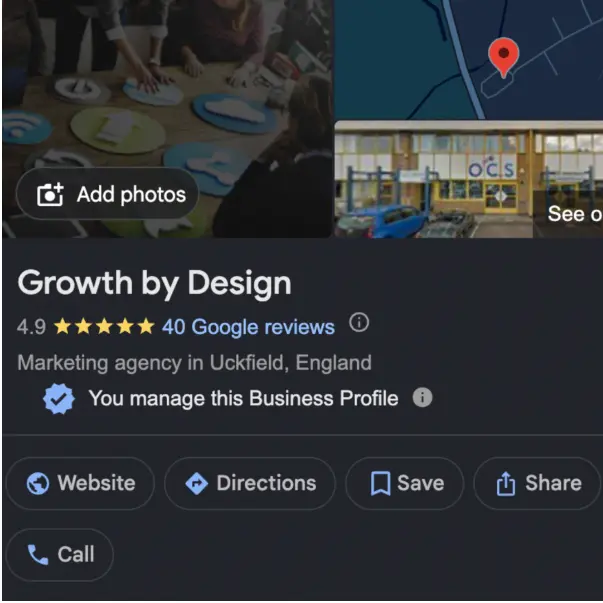
Google confirms that local rankings are based mainly on relevance, distance and prominence, with complete business information, reviews and positive ratings all playing a role. Google Business Profile is now also managed directly through Search and Maps, with advanced settings covering phone visibility, Google Ads phone numbers, automated calls and texts, data sharing, and performance insights.
For your business, it means your profile cannot be treated as a one-off setup task. It needs regular monitoring, accurate information, real photos, properly structured services, review management and a clear connection to your wider SEO strategy. If it is not being managed properly, your competitors are not just appearing ahead of you; they are making it easier for your customers to trust them instead of you.
Why your Google Business Profile matters more in 2026
For your business, a Google Business Profile is now likely to be one of the first meaningful interactions someone has with you. It appears directly in Google Search and Google Maps, often before a potential customer reaches your website, reads a service page, or speaks to anyone in your team.
A few years ago, it was easy to think of Google Business Profile as a directory listing. It held your name, address, phone number and opening hours, and that was often enough to make it useful. In 2026, that is no longer the case. Your profile now carries far more weight because it brings together the information people use to make fast decisions, including reviews, services, photos, opening hours, contact options, updates and directions.
Google also makes it clear that complete and accurate business information helps it better understand your business and match your profile to relevant searches, because local search is not only about being online; it is about being selected at the exact point someone is ready to act.
If your profile is incomplete, outdated or unclear, the problem is not just that it looks poor. The bigger issue is that it creates doubt. Google has less confidence in what you do, and your potential customers have less confidence in choosing you.
That is why we look at Google Business Profile as part of your wider marketing system, not as a separate admin task. If it is the first thing people see, it needs to work as hard as your website, SEO, content, social media, and paid advertising.
How Google decides whether your business appears in local search
Google’s local ranking model is built around three core factors: relevance, distance and prominence.
Relevance is how well your Business Profile matches what someone is searching for. Your categories, services, business description, and the level of detail across your profile influence how well it comes across.
Distance is how close your business is to the person searching, or how relevant your service area is to their location.
Prominence is how well known, trusted and established your business appears to be. Google specifically cites review count and review score as factors that can help with local ranking, alongside broader information about your business across the web.
The important point here is that you cannot control every part of the equation, but you can control more than you may realise. You cannot change where someone searches from, but you can make your profile clearer, more complete, more active, and more trustworthy.
That is why your business may perform very differently from a competitor in the same area, even if your services are similar; one profile may have better service information, more recent photos, stronger reviews, clearer customer actions and a stronger connection to the wider website. Another may technically exist online, but fail to send enough useful signals; from Google’s perspective, the stronger profile is easier to understand, and from your customer’s point of view, it is easier to choose.
At Growth by Design, we look at what Google is likely to understand from your profile, what your competitors are doing better, and what needs improvement, so your business is easier to find and more trusted.
Why the old “set it and forget it” approach no longer works
One of the biggest reasons Google Business Profiles underperform is that they are treated as finished once they are created. Your business may have added the basics, uploaded a logo, and added a few photos, then assumed the job was done. Now that approach leaves too much to chance.
Google Business Profile is now managed directly through Google Search and Maps, and verified businesses can update key details such as address, hours, contact information and photos to keep information accurate and up to date. Google also provides advanced profile settings, including Business Profile ID, automated calls and texts, phone number visibility, labels, store codes, Google Ads phone numbers, and data sharing preferences. This is not the structure of a simple listing; it is a live, important, business asset.
If no one is checking your profile properly, several things can start to go wrong. Your opening hours may become outdated, the services may not reflect what you actually want to sell, and your photos may look old or generic. Reviews may sit unanswered or have a poor reply. Performance data may be ignored, even though it shows whether people are calling, clicking through to your website, requesting directions or messaging.
A profile that is not being actively managed can quickly become less accurate, less persuasive, and not useful to potential customers.
For your business, that means missed enquiries can happen quietly; you may not notice a sudden drop, but over time, competitors with more active and complete profiles start to look more reliable, their content is current, sometimes seasonal, and they are easier to contact.
The profile details that make the biggest difference
The strongest Google Business Profiles are not necessarily the ones with the most information. They are the ones where the information is accurate, structured and useful to the end user.
Categories matter because they tell Google what your business primarily does. Google advises businesses to choose the fewest number of categories needed to describe their core business accurately, rather than adding every possible option, this is important because poor category choices can confuse relevance rather than strengthen it.
Services are important because they help both Google and your customers understand what you actually offer. A vague service list leaves people guessing; a clear one gives them confidence that they are in the right place.
Opening hours are essential because they remove hesitation. If someone is ready to call, visit, or book, uncertainty about availability can stop the action before it happens and lead to a competitor with those details being contacted instead.
Photos make your business feel real. Google’s own photo guidance says images should be in focus, well-lit, not heavily altered, and should represent reality, so avoiding the use of photostock images gives a clear signal that your own genuine business imagery is more valuable than generic, over-polished, or stock-style visuals.
Posts and updates are done regularly throughout the month because they allow you to share announcements, offers, events and updates directly on Search and Maps. Google states that these updates help customers decide whether to visit a business, and Google now likes to see updates at least every 30 days.
None of these elements should be managed in isolation; together, they create a profile that feels current, easy to gain information from, credible and easy to act on.
When we manage a profile at Growth by Design, we do not treat these areas as separate boxes to tick; we consider how they work together. Your categories should support your SEO focus, and your services should reflect what your customers are searching for. Photos should reinforce trust by using real life imagery of your own. Updates should show activity in the month, projects you are undertaking, or social media posts you are putting out on various platforms. Your review responses should sound like your business is replying personally, not like a templated, generic answer.
Why real photos and regular updates now matter so much
A common mistake is to treat photos as decoration or a nice-to-have image. They are not. On your Google Business Profile, images help people judge whether your business feels active right now, professional, the type of business they are actively looking for, and trustworthy.
It is especially important in sectors where trust is built before contact, if someone is choosing a builder, installer, garage, training provider, clinic, showroom, restaurant or professional service, they want to see evidence that your business is real and credible, they want to see people, places, work, products, vehicles, premises, projects or the customer experience and that is why stock imagery is weak, it might look neat and tidy, however, it does not show your potential customers the real you, nor does it separate your business to give you that essential point of difference.
Google’s guidance is clear that business profile photos should represent reality, with no excessive filters or significant alterations, and this supports the wider direction of search in 2026, where authenticity, signals of usefulness and evidence carry more weight than polished generic content. That is what will signal to Google’s algorithms that your business should be ranking highly in search results.
For Growth by Design clients, we look beyond “does your profile have photos?” and ask better questions.
- Do the photos reflect your business as it is now?
- Do they support the services you want to sell?
- Do they help a customer understand what to expect?
- Do they make your business look active and credible?
- Do they match the message on your website and wider marketing?
A good photo strategy is not about uploading random images. It is about giving both Google and your customers stronger evidence of who you are and what you do, and that is also why regular updates matter. If your profile has not changed for months, it can start to feel neglected. Even if the information is still technically correct, fresh images, useful posts, and accurate service updates help show that your business is active now, not just that it existed when the profile was first created.
Reviews are not just about reputation; they influence local visibility
Reviews have always mattered, but they now need to be treated as part of a structured marketing process rather than something that happens occasionally. Google states that more reviews and positive ratings can improve local ranking. It also advises businesses to respond to reviews, because replies show that the business values customers and their feedback.
The importance lies in the fact that your potential customers are not only looking at star ratings; they are also looking at the number of reviews, how up-to-date they are, what people are saying about you, and how your business responds to reviews, whether positive or negative.
A thoughtful review response shows professionalism; conversely, a generic reply can feel lazy, and no reply at all can suggest that your business is not paying attention or might not still be operating.
There is also a trust issue around fake engagement. Google has strengthened its approach to fake reviews. In the UK, the Competition and Markets Authority announced that Google had agreed to improve detection and action against fake reviews, including stronger sanctions for businesses involved in fake review activity.
That means your review management has to be done properly; it should be consistent, ethical, and based on genuine customer experiences. The aim is not to manipulate the profile, but to ensure happy customers are encouraged to share genuine feedback and that your business responds in a way that builds trust.
At Growth by Design, we help make this more structured. That might mean considering how you ask for reviews. That can be done, for example, via email marketing, by leaving a leaflet with a QR code, or by simply having a link on your website. We can also advise on improving the wording of your responses, identifying missed opportunities, and making sure review activity supports your wider credibility rather than feeling like an afterthought.
What changed with Q&A and why your website now matters more
For years, the Questions and Answers section on Google Business Profile has given businesses a simple way to answer common customer questions directly on their profiles, but it has now changed.
Google discontinued the Google Business Profile Q&A API in November 2025, with the public-facing Q&A function being phased out afterwards. The practical impact is that you can no longer rely on that feature as the main place to manage customer questions.
The impact on your business is that your wider marketing strategy matters. If Google is using profile information, website content, reviews, and other public sources to understand what your business does, then your answers need to exist in more than one place. They should be built into service pages, blog content, well-structured schema FAQs, review replies, business descriptions and clear website copy.
It is also one of the reasons Google Business Profile management should not be handled separately from SEO. Your profile and your website need to support each other; if the profile says one thing, the website says another, and reviews mention something else entirely, the signals become weaker, which will affect your Google search ranking and positioning.
At Growth by Design, it is just one of the areas we pay close attention to; we do not view the profile as a standalone asset. We look at whether the information Google is reading across your online presence is consistent, what your potential customers are searching for, and whether the information is up to date. If your website and profile do not answer and align with those questions clearly, your competitors may answer them better.
Why Google Business Profile performance data should not be ignored
A well-managed Google Business Profile gives you more than visibility; it gives you performance data that can help shape your marketing decisions and direction.
Google confirms that Business Profile owners and managers can check views, clicks and customer interactions across Search and Maps. These performance insights help you understand how people interact with your profile over time and can reveal the intent behind the searches being used.
A website visit is useful, but a direct call, a request for directions, a message, or a booking can be even more commercially valuable to your business, as these are actions taken by people who may already be close to making a decision.
If data is not reviewed, you miss the opportunity to understand what is working and to spot problems early. For example, if views are increasing but calls are not, there may be a conversion issue, if people are finding your profile for the wrong services, your profile may need amending, if a competitor is appearing more often in map results, you may need to strengthen reviews, services, content and local signals, such as your address or if you own multiple sites, making sure you have unique listings for each of them.
At Growth by Design, we look at data as part of the bigger picture. We want to understand whether your profile is attracting the right people, whether those people are taking action, and whether the journey from profile to enquiry is clear enough. It is not just about making your profile look neat and tidy; it is about using the data to improve outcomes.
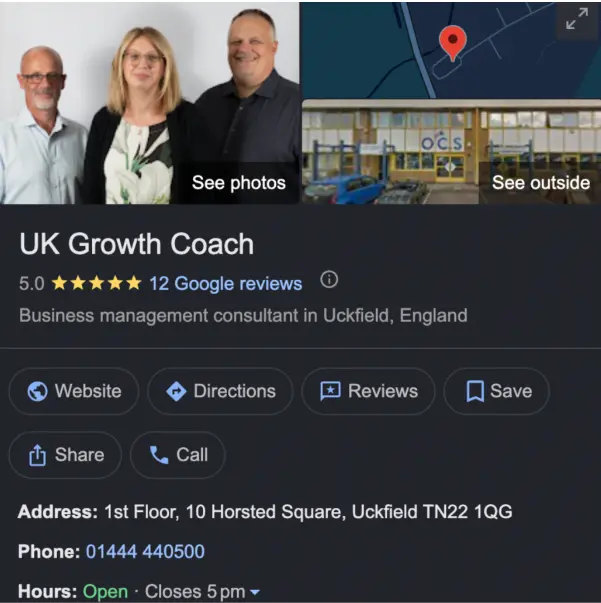
Where your business could be losing enquiries without realising it
The biggest losses are often not dramatic to change or update, but they are small points that quietly stop people from choosing you over a competitor.
A customer searches for a service and sees three local options, for example, one has recent reviews, clear services, current, real business photos and an easy way to call or message. In contrast, another has limited information, no recent updates and unanswered reviews; even if the second business is excellent in real life, the first one looks easier to trust.
Common problems include poor category choices, incomplete service descriptions, old photos/stock imagery, no review process, unanswered reviews, incorrect hours, missing information, weak calls to action, poor website links, outdated URL’s, lack of ownership access, and no regular monitoring.
There is also the risk of relying on Google to interpret your business without enough clear information from you; if you do not provide strong, accurate signals, Google still has to make decisions. That is why proper management is not optional if your business relies on local search; it protects your business’s visibility, improves trust and gives customers fewer reasons to look elsewhere.
This is also where an external view can be incredibly useful; you may be too close to your own business to spot the gaps. We look at your profile the way a customer and Google would, then identify what needs to be corrected, strengthened, added, removed or managed more consistently.
How Growth by Design manages your Google Business Profile properly
At Growth by Design, we do not see your Google Business Profile as a minor admin task; we see it as part of the wider visibility, credibility and conversion system that helps your business generate enquiries from the right sort of potential customers.
Your profile should not just exist; it should support your business commercially and be treated as a business priority.
That means looking at what you want to be found for, where you want to be visible, in categories and areas, what your customers need to understand, and what might be stopping them from taking action.
Our approach looks at the full picture: your categories, services, descriptions, photos, updates, reviews, website alignment, competitor visibility, performance data and conversion points. We also look at whether your profile is properly owned, whether access is secure, and whether the information matches what is shown across your website and wider online presence.
It is important because your Google Business Profile does not work in isolation; it connects to your SEO, content, Google Ads, Local Services Ads, website performance, conversion rate optimisation and reputation management.
You can have visibility and still lose enquiries; that is why our focus is not only on whether people can find you, but also on whether they understand what you offer, trust you, and have a clear reason to contact you.
Why professional management gives your business a stronger result
You can update a Google Business Profile yourself, and many business owners do. The problem is rarely whether you are capable of making changes. The problem is whether you have the time, consistency, and search knowledge to manage it properly.
Google Business Profile management is not just uploading a post now and again; it involves verifying information accuracy, monitoring performance, reviewing competitor activity, keeping services aligned with search intent, updating imagery, responding to reviews, tracking customer actions, and ensuring the profile supports the wider marketing strategy.
Not every service should be pushed equally, certainly not every keyword belongs in the profile and definitely not every photo helps. Also, every review reply should not sound the same.
Growth by Design adds value: we manage your profile with the same thinking we apply to SEO and conversion, ensuring the activity has a clear purpose and supports the commercial outcome.
The goal is not to make your profile look busy. The goal is to make it work harder.
What this means for your business now
If your Google Business Profile has not been reviewed properly for months, it is probably not doing everything it could. It does not always require a complete overhaul, but it does require proper attention.
A strong Google Business Profile should answer three questions quickly:
Can Google understand what your business does?
Can customers trust what they see?
Is it easy for them to take the next step?
If the answer to any of those is weak, there is work to do.
Growth by Design’s approach
Google Business Profile management works best when it is connected to the rest of your marketing. It should support your SEO, strengthen your local search visibility, reflect your brand properly and help convert searches into real enquiries.
At Growth by Design, we look at where your profile is now, where your competitors are ahead, and what needs improvement so your business is easier to find, easier to understand, and easier to contact.
We can audit the current profile, identify missed opportunities, correct the structure, improve the content, build a stronger review and update process, and manage it consistently so it performs at the level it should.
If you want your Google Business Profile to move beyond being “set it and forget it” and start working properly as part of your marketing, we can help.
📞 Call us on: 01444 810530
📧 Email: connect@growth-by-design.co.uk
📅 Book directly into our diary: https://calendly.com/louisegrowthbydesign/30min
If you enjoyed this article, you might also enjoy
Google’s spam policies update: what it means for websites in 2026
Google Spam Policy Update
FAQs about Google Business Profile optimisation in 2026
1. Why is Google Business Profile important for local SEO?
Google Business Profile is important because it helps Google understand what your business does, where you operate, and how trustworthy you appear. Google’s local rankings are based mainly on relevance, distance and prominence, and a complete, active profile helps strengthen the parts of that system you can influence.
2. How often should your Google Business Profile be updated?
Your profile should be checked regularly and updated whenever information changes. For most businesses, monthly updates should be the minimum, with more frequent activity in competitive sectors. Posts, photos, review replies and service updates all help keep your profile current.
3. Do Google reviews affect your local rankings?
Yes. Google states that more reviews and positive ratings can help local ranking. Reviews also influence customer trust, especially when they are recent, detailed and properly responded to by your business.
4. Should you use stock photos on your Google Business Profile?
No. Google’s photo guidance says images should represent reality, be in focus, well lit and not heavily altered. Real photos of your team, premises, work, products or customer experience are far more valuable than generic stock imagery.
5. Can your Google Business Profile help generate enquiries without a website click?
Yes. Many customers take action directly from your profile by calling, requesting directions, messaging, booking or reading reviews, meaning your profile may influence the decision before someone reaches your website.
6. What should be included in your services section?
Your services should clearly reflect what you want your business to be found for and what your customers are likely to search for. Each service should be specific enough to remove confusion and should align with the language used across your website and wider marketing.
7. What happens if your Google Business Profile information is wrong?
Incorrect information can damage both trust and visibility. Wrong hours, old phone numbers, unclear services or poor location details can stop people from contacting you and may reduce Google’s confidence in your profile.
8. Why does your Google Business Profile need professional management?
Professional management helps ensure your profile is not just filled in, but actively working as part of your wider marketing, including structure, SEO alignment, review strategy, performance monitoring, competitor checks, content updates and conversion improvements.
9. Does Google Business Profile work with Google Ads?
Yes. Google Business Profile can connect with Google Ads through location assets and related settings, including Google Ads phone numbers, and can help keep paid and local visibility aligned when set up properly.
10. How can Growth by Design help with Google Business Profile optimisation?
Growth by Design can audit your profile, identify where your competitors are ahead, improve your services, categories, photos and content, support your review process, monitor performance and manage your profile as part of your wider SEO and marketing strategy.