

We tested Grok vs ChatGPT and Gemini across real marketing and business tasks. Grok is sharp for live social sentiment but carries higher brand and compliance risk, ChatGPT is the most adaptable for structured thinking and production, Gemini is strongest inside Google workflows, the winning approach is not picking one tool, it is putting clear strategy, governance and tone control around any tool so your output turns into outcomes.

Generative artificial intelligence is no longer a novelty for business owners. It now sits alongside your inbox, your documents, your customer service processes, and your marketing planning. Because of that, we are increasingly being asked the same question in slightly different ways.
Which one should we be using, Grok, ChatGPT, or Gemini, and will any of them replace what we pay you for?
To answer that properly, Louise from Growth by Design spent time testing all three platforms across the areas our clients actually care about, including messaging, positioning, research, content, lead generation support, and internal productivity. What follows are her findings, based on real use rather than feature lists.
The aim of this article is to cut through assumptions and overconfidence around AI output. These tools can produce work that looks finished and sounds convincing, while still quietly undermining trust, brand clarity, compliance, or lead quality if they are not used carefully.
We are already seeing real-world consequences of this. Ofcom’s current investigation into X over Grok-generated sexualised imagery shows how quickly brand and regulatory risk can escalate when AI output is not properly governed.
This article is grounded in practical experience rather than theory. Where technical terms are unavoidable, they are clearly explained just before the FAQ section at the end, so the main discussion remains accessible throughout.
Why Grok has become the one clients suddenly bring up
Grok’s growth makes sense. It is tightly linked to X, it plays in real time, and it presents itself as bold and unfiltered. That style gives people the feeling they are getting the raw truth, straight from the live conversation.
In business terms, that means Grok can look attractive for keeping an eye on what people are saying about your brand and what topics are taking off, especially if your audience lives on social media. However, it can also push teams into reacting too quickly, and reactive marketing is one of the fastest ways to lose clear positioning.
There is also a second reason Grok is in the spotlight: It is being scrutinised by regulators and watchdogs because of how its image features have been used and how safeguards are being handled. In the UK, the ICO has publicly said it has contacted X and xAI to seek clarity on measures to comply with UK data protection law and protect individuals’ rights. That is not a small footnote if you are a business that cares about reputation and risk.
If I am advising business owners, the question is not, “Is Grok clever?” It is, “Is it appropriate for how we work, and what could go wrong if we use it casually?”
The real business question is not “which AI systems are best”, it is “what are we using AI for”
Most businesses start AI usage backwards. They pick a tool, then search for tasks to justify it.
The better approach is to split needs into four buckets:
- Real-time awareness, what is being said, what is trending, how people feel about it
- Workflow productivity, email, docs, summaries, internal analysis
- Strategic thinking support, planning, positioning, synthesis, decision clarity
- Production support, content drafts, landing page structure, ad variants, sales enablement assets
Each tool has strengths and weaknesses across these buckets. Once you understand that, you stop treating AI like a replacement for thinking and start using it as a multiplier for good teams.
My practical comparison table, written for business owners, not AI fans
Here is my original comparison table based on day-to-day business use, rather than the AI excitement that has swept through businesses.
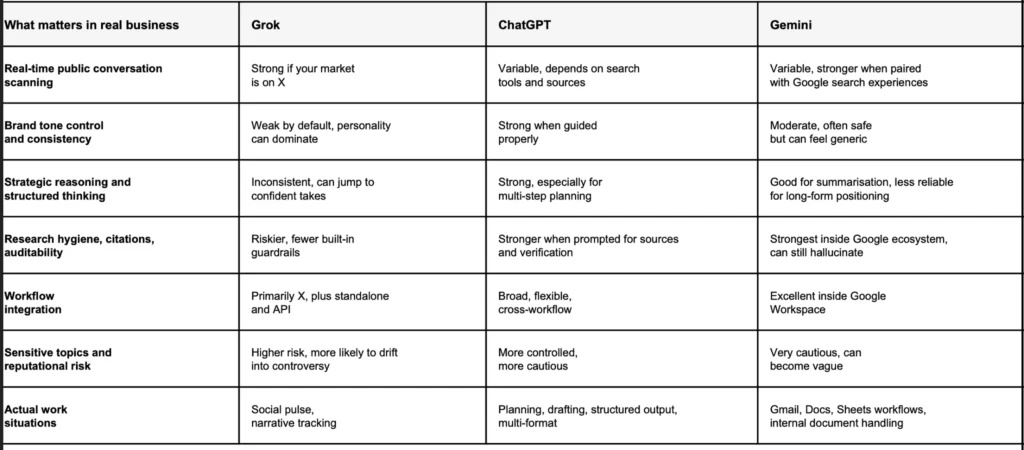
Bringing it down to the basics: Grok is the loudest, ChatGPT is the most flexible, Gemini is the most embedded.
The key is that none of them replace what a business actually needs, which is direction, judgment, and accountability.
What I found when I tested Grok on business tasks
Where Grok genuinely helps
If you are doing anything that depends on fast-moving public conversations, Grok can be useful. It is tightly integrated with X and positioned as a tool for real-time context, making it well-suited to capturing what people are saying right now. xAI itself positions Grok as available through grok.com and its apps, and it has developer tooling and API access that includes “Live Search” type capabilities.
In practice, Grok helped most with:
- Spotting themes in fast-moving conversations within the app
- Pulling out clusters of opinions and counter-opinions
- Surfacing language people actually use, which can be valuable for ad copy testing and social messaging.
Where Grok becomes a business liability
The two biggest issues I ran into were tone drift and trust drift.
Tone drift is when the tool’s built-in personality starts writing your brand. That is a problem because your brand voice is a commercial asset, not a general vibe. Most business owners do not realise how quickly an inconsistent voice can undermine reputation and market positioning. It makes you sound changeable, and changeable brands struggle with consistency across the business.
Trust-drift is subtler. It is when a tool gives you information with confident delivery, and you stop checking it properly. Grok’s style can make that more likely, because its identity leans into directness.
There is also the wider reputational risk issue. Grok has been under heavy scrutiny recently due to how its image and editing capabilities have been misused for sexualised or non-consensual images, which has triggered regulator attention and enforcement action in multiple countries, and data retention orders in the EU relating to Grok documentation. That broader context matters for businesses choosing tools and setting policy, because it changes the risk conversation from “a clever chatbot” to “a platform under scrutiny.”
For me, when advising our clients, the message is simple:
Grok can be useful, but it should be used with tight rules, especially around reputation, compliance, and image use.
What I found when I tested ChatGPT on business tasks
ChatGPT is still the best all-rounder for most businesses because it is adaptable. It is not tied to one ecosystem, it handles structured tasks well, and it can support everything from planning to production.
OpenAI’s own documentation and product updates show ongoing expansion of capabilities across workflows, including agent-style functions and new types of research experiences, which is exactly why it fits business use better than tools designed around a single social platform.
Where ChatGPT helps most
- Turning messy ideas into clear structure
- Drafting content quickly, then refining it into brand tone
- Building outlines for blogs, landing pages, ad campaigns, email sequences
- Translating strategy into usable assets, without losing the thread.
ChatGPT also wins on consistency when you give it proper constraints, brand voice notes, and examples. That is the difference between “AI wrote this” and “this sounds like our business, just faster.”
Where ChatGPT can still cause problems
The risks are not unique to ChatGPT, but they appear often because ChatGPT is the tool people use for everything.
- It can still hallucinate facts if you do not force verification
- It can overproduce, creating volume without usefulness
- It can write convincingly generic content that does not differentiate you.
The number one failure mode I see is business owners using ChatGPT to generate marketing without a core reference point, like a unique feature, comparison, or emotional connection. This produces content that is technically fine, but commercially weak.
What I found when I tested Gemini on business tasks
Gemini shines when the work happens inside Google. If your life is Gmail, Docs, Sheets, Calendar, and Drive, then having AI inside those tools is a genuine productivity advantage.
Google has been clear that Gemini is designed to integrate into Workspace experiences through its subscription tiers.
Where Gemini helps most
- Summarising long email threads and documents
- Drafting inside Docs quickly
- Working across long files and large context, especially when you need to reference internal material.
Gemini is also more naturally aligned to businesses that need guardrails and a cautious style.
Where Gemini can frustrate
For brand-led marketing work, Gemini can lean too safe. The outputs can feel like they were written to avoid risk rather than to win attention and create desire. That is fine for internal summaries, less fine for positioning, campaign strategy, or premium tone.

The uncomfortable truth, AI makes marketing faster, it does not make it wiser
AI tools optimise for producing an answer, quickly. Businesses need outcomes, which means making judgments, prioritising, and exercising restraint.
A few examples of how AI can quietly hurt a business:
- Overpromising claims that create short-term leads but long-term distrust
- Messaging that attracts the wrong buyers, then destroys conversion rates
- Content that ranks poorly because it lacks experience and originality
- A social feed that feels inconsistent, which makes the brand feel inconsistent
- Decision-making driven by what is trending rather than what is profitable.
This is why the conversation should never be “AI vs agency.” It is “tool vs system.”
A tool without a system creates a mess faster.
The bad things clients should be aware of, with all AI
1. AI can damage tone of voice fast
Most clients think brand voice is a nice-to-have. It is not.
Brand voice is how your market recognises you, trusts you, and decides you are worth paying more for. If AI changes your voice every week, your brand stops feeling stable.
2. AI creates fake confidence
AI will give you a fluent answer even when it is guessing. That is why verification matters. This becomes more important when the topic touches law, safety, finance, health, or regulated claims.
3. AI can create reputational risk through association
This is where Grok is the obvious example right now. When regulators and major media are scrutinising a tool for misuse, it changes how stakeholders perceive your judgment if you use it recklessly, especially for anything public-facing or image-related.
4. AI can standardise your marketing into mediocrity
If everyone uses the same tools in the same way, everyone ends up sounding similar. Differentiation comes from thinking, not from software.
How I would tell clients to use Grok vs ChatGPT and Gemini responsibly
Here is the practical “do this, not that” view.
Use Grok for
- Social listening, tone sensing, narrative scanning
- Checking how conversations are forming in public
- Quick language capture for audience phrasing
Do not use Grok for
- Final marketing copy
- Anything regulated
- Anything where reputation is fragile
- Image creation or editing for business use, unless you have strict controls
Use ChatGPT for
- Strategy clarification and planning support
- Content drafting, then editing into brand voice
- Structuring campaigns across channels
- Turning expertise into clear, helpful content
Do not use ChatGPT for
- Facts you have not verified
- One-click publishing without human review
- Copying competitor messaging patterns
Use Gemini for
- Internal productivity inside Google Workspace
- Document summarisation and internal drafting
- Working with large internal files
Do not use Gemini for
- Brand-first creative work without heavy guidance
- Differentiated positioning without strategy input
Where Growth by Design fits, and why AI actually strengthens the agency role
This is the honest position.
We do not sell “content.” We sell direction, and we translate that direction into marketing that performs.
AI makes the execution part faster. It does not replace the part that decides:
- What we should say
- What we should not say
- Who we are speaking to
- What we want the market to believe
- What proof we need to earn trust
- What channels and formats will actually move the needle
- What to prioritise when time and budget are real constraints
A business owner, such as yourself, can absolutely use AI to write a blog.
What you most likely need help doing and doing consistently is:
- Maintain a coherent, on brand voice
- Build a content plan for the months ahead, aligned to commercial objectives
- Avoid compliance and reputational pitfalls
- Create a system where content turns into enquiries, and enquiries turn into sales
That system is what you are paying for. AI becomes a component inside it.
My conclusion after testing all three
If I had to summarise it cleanly for clients:
- Grok is useful for social pulse, but higher risk, and needs stricter guardrails
- ChatGPT is the most versatile for planning and production, and the easiest to make “sound like you” with the right inputs
- Gemini is excellent inside Google workflows, and often the best choice for internal productivity
The businesses that will win in 2026 will not be the ones using the most AI. They will be the ones using AI with the clearest strategy, the strongest brand discipline, and the best quality control.
AI can generate output. At Growth by Design, we build the strategic marketing plans that turn output into outcomes.
What this means for your business, right now
AI is not replacing search, but it is changing how people discover, assess, and decide which businesses they trust. Google still plays a major role, but it no longer sits alone. Tools such as ChatGPT, Gemini, and Grok are already shaping decisions, often before someone ever reaches a website.
For SMEs, this subtly shifts the rules. Visibility is no longer just about rankings. Trust, clarity, consistency of voice, and demonstrable expertise now carry more weight than ever. Businesses that rely purely on surface-level SEO or high-volume content risk being overlooked, even when their rankings appear strong.
This does not mean walking away from what already works. SEO still matters. Websites still matter. However, they now need to sit within a wider strategy that considers how your brand appears in AI-generated summaries, how credible your content feels, and whether your messaging is genuinely useful rather than simply optimised.
That means thinking beyond keywords alone. Structure, authority, partnerships, and the clarity of your expertise all play a part. This is where GEO and SEO begin to support each other, rather than compete.
At Growth by Design, we help SMEs respond to changes like this calmly and strategically, without panic or guesswork. If you want to understand how your business can protect its visibility, strengthen trust, and adapt confidently as search continues to evolve, we would be happy to talk it through.
📞 Call us on 01444 810530
📅 Book directly into our diary: https://calendly.com/louise-growth-by-design/30min
The technical terms for Grok vs ChatGPT and Gemini explained, in plain English
What is generative artificial intelligence, and how is it actually used in business?
Generative artificial intelligence refers to AI systems that create new content, such as written copy, images, summaries, or plans, by predicting patterns from large datasets, rather than simply retrieving existing information. In business, this is most often used for drafting content, organising ideas, summarising information, and supporting planning and analysis.
What does “AI hallucination” mean, and why does it matter for business decisions?
AI hallucination describes a situation where an AI tool confidently produces information that sounds correct but is factually wrong or invented. This matters because unchecked hallucinations can lead to incorrect claims, poor decisions, compliance issues, or reputational damage.
What is social sentiment analysis, and how do businesses use it?
Social sentiment analysis looks at public online conversations to understand how people feel about a topic, brand, or issue. Businesses use it to track opinion shifts, test messaging, and understand how language and narratives are forming in real time.
What does workflow integration mean when we talk about AI tools?
Workflow integration refers to how AI tools operate inside everyday business systems such as email, documents, spreadsheets, or calendars, rather than as standalone tools. Well-integrated AI saves time by reducing switching between platforms.
What is an API, and why does it matter for AI platforms?
An API, or Application Programming Interface, is a technical connection that allows different software systems to communicate with each other. In AI tools, APIs enable automation, data sharing, and custom workflows between platforms.
What does “live search” mean in an AI context?
Live search describes AI tools that can access up-to-date or real-time information rather than relying only on pre-trained or historical data. This is particularly useful for monitoring fast-moving conversations or current events.
What are data protection laws, and how do they affect AI use in the UK?
Data protection laws govern how personal data is collected, stored, and processed, and they apply equally to AI tools. In the UK, businesses are responsible for ensuring AI use complies with these laws, especially when handling customer or employee data.
What is the Information Commissioner’s Office (ICO), and why is it relevant to AI?
The Information Commissioner’s Office is the UK regulator responsible for data protection and privacy. It plays a role in overseeing how organisations use technologies, including AI, when personal data and individual rights are involved.
What is reputational risk, and how can AI increase it?
Reputational risk refers to the potential damage to trust or credibility caused by business decisions or associations. AI can increase this risk if tools are used carelessly, produce misleading content, or are linked to controversial platforms or practices.
What is Google Workspace, and why does it matter when choosing AI tools?
Google Workspace is Google’s collection of business productivity tools, including Gmail, Docs, Sheets, and Drive. AI tools that integrate directly into Workspace can significantly improve internal productivity for businesses already using these systems.
What are AI guardrails, and why should businesses put them in place?
AI guardrails are rules and controls that define how AI tools can and cannot be used. They help protect brand voice, ensure compliance, reduce errors, and prevent AI from quietly undermining trust or consistency.
Frequently asked questions about Grok vs ChatGPT and Gemini for business
What is the real difference between Grok vs ChatGPT and Gemini for business use in 2026?
The difference is not about which tool is “best,” but what each is designed to do. Grok is strongest for real-time social conversation and sentiment tracking, particularly on X, but carries higher reputational and compliance risk. ChatGPT is the most adaptable across planning, drafting, and structured thinking. Gemini works best inside Google Workspace, supporting internal productivity rather than brand-led marketing. Businesses get the best results when they match the tool to the task, not the other way around.
Which AI tool is safest to use for marketing without damaging brand trust?
ChatGPT is generally the safest option for marketing when it is used with clear brand guidelines, human review, and proper verification. Grok can introduce risk due to tone drift and its association with live social narratives, while Gemini can be overly cautious and generic for outward-facing marketing. Safety comes less from the tool itself and more from how tightly it is governed.
Can Grok be useful for businesses, or does it carry too much reputational risk?
Grok can be useful for monitoring fast-moving public conversations and understanding how language and narratives are forming. However, it carries higher reputational risk if used casually, especially for public-facing content or image-related tasks. Businesses should treat Grok as a listening and sensing tool, not a publishing tool.
Why does ChatGPT work better for structured thinking and content planning?
ChatGPT performs well because it handles multi-step reasoning, structure, and iteration effectively. It is well suited to turning rough ideas into organised plans, outlines, and drafts that can then be refined into brand voice. When guided properly, it supports thinking rather than replacing it.
Is Gemini better suited to internal productivity rather than brand-led marketing?
Yes, in most cases. Gemini excels inside Google Workspace, helping teams summarise emails, work through documents, and handle large internal files. For brand-led marketing, however, it can feel overly safe and generic, which limits its effectiveness for positioning or premium messaging.
Should businesses choose one AI tool, or use different tools for different tasks?
Most businesses benefit from using different tools for different purposes. AI works best when it supports specific needs, such as planning, productivity, or social listening, rather than being forced into every role. Strategy should come first, with tools selected to support it.
How can AI quietly damage lead quality even when the content looks good?
AI-generated content can attract the wrong audience if it lacks clear positioning or real expertise. This leads to higher enquiry volume but poorer conversion, wasted time, and weaker sales outcomes. Lead quality drops when content is technically fine but commercially unfocused.
What are the biggest risks of using AI without clear rules or oversight?
The main risks include inconsistent brand voice, overconfident misinformation, compliance issues, and reputational damage through association with controversial platforms or claims. Without guardrails and human review, AI can scale mistakes faster than it scales results.
Can AI replace a marketing agency, or does it change the agency’s role?
AI does not replace strategic marketing. It speeds up execution, but it does not decide what should be said, who should be targeted, or how trust is built. Agencies increasingly focus on direction, judgement, positioning, and systems, with AI acting as a tool inside that framework.
How should SMEs use AI to improve outcomes without losing brand control?
SMEs should use AI to support thinking, structure, and efficiency, while keeping strategy, voice, and decision-making human-led. Clear rules, verification processes, and a defined brand position are what allow AI to improve outcomes without eroding trust or consistency.